Your cat is either climbing the curtains or shredding your couch, and you’re tired of choosing between the two. A good cat tower with scratching post solves both problems at once, giving your cat a tall place to survey the room and a legal outlet for that scratching instinct. The trick is finding one that’s sturdy, sisal-covered, and actually tall enough to keep a bored or territorial cat interested.
If you’ve searched "cat tree scratching post" and gotten lost in a hundred nearly identical Amazon listings, this list cuts through that. We tested and researched eleven cat condo scratching post combos based on stability, scratch surface durability, and how well cats in multi-cat households actually use them, not just how they look in a product photo.
Below you’ll find picks for small apartments, multi-cat homes, kittens, and heavy-duty scratchers who destroy flimsy posts in a week. And since a scratching post cat tree only works if your cat prefers it over the couch, we’ll also touch on placement and how to train a cat to stop scratching furniture so these towers earn their keep from day one.
1. How to choose a cat tower with a scratching post
Before you scroll through eleven options, it helps to know what actually separates a cat tower with scratching post your cat will use daily from one that becomes an expensive coat rack. Cats are picky about texture, height, and stability, and a wobbly tower or the wrong scratch material will send them right back to your armchair.
Stability and base weight
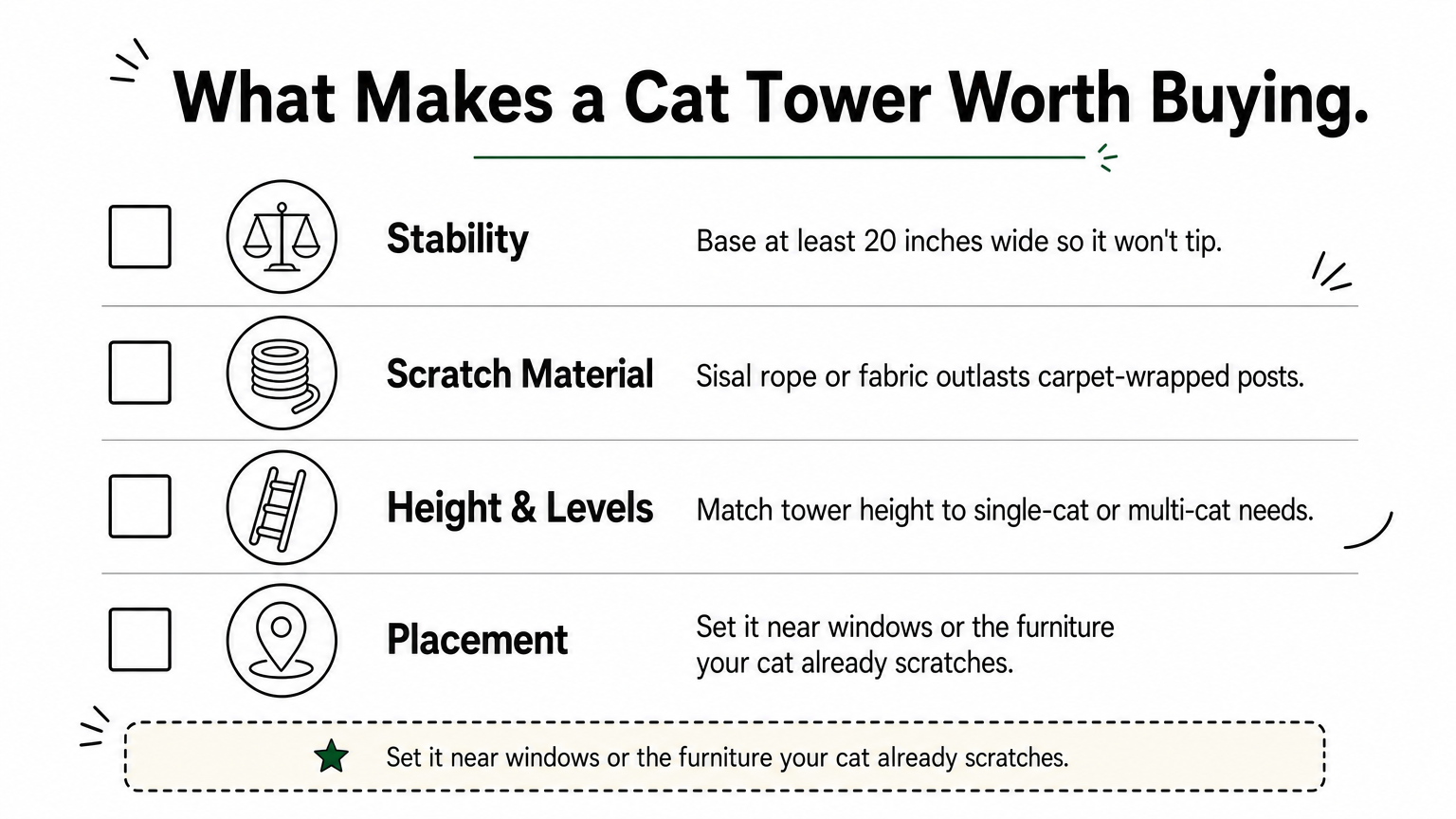
Check the base diameter and total weight before you buy. A cat tree with scratching post that tips or wobbles when your cat jumps on it will get abandoned fast, especially by cats over 12 pounds. Look for a base at least 20 inches wide, and read reviews mentioning wobble on hard floors versus carpet.
A tower your cat won’t trust its balance on is a tower your cat won’t use.
Scratch surface material
Sisal rope and sisal fabric outperform carpet-wrapped posts almost every time. Carpet frays and mats down, and cats often prefer the rough, vertical grain of sisal because it mimics tree bark and lets them dig in and pull. When you’re comparing a cat scratching post cat tree combo, run your hand over the post material in photos or reviews before adding to cart, the same way we compared the top scratching posts for 2026.
Height and number of levels
Taller isn’t automatically better, but height matters for territorial cats and multi-cat households where vertical space reduces conflict. A single cat in a small apartment might do fine with a 20 to 30 inch tower, while a household with two or three cats benefits from a 60-plus inch cat condo scratching post setup with multiple perches.
| Household type | Recommended height | Post material | Levels |
|---|---|---|---|
| Single cat, small space | 20-30 in | Sisal fabric | 1-2 |
| Single cat, active/large breed | 40-60 in | Sisal rope | 2-3 |
| Multi-cat home | 60+ in | Sisal rope | 3-5+ |
| Kitten | 20-30 in | Sisal fabric | 1-2 |
Placement over aesthetics
Even the best-built tower fails if it sits in a corner your cat ignores. Place it near a window, next to the furniture your cat currently scratches, or in a high-traffic room where your cat wants to be near you. Once your cat picks a spot, resist the urge to relocate it for looks, since consistency is what makes redirection training stick over the following weeks.
2. Best overall: Yaheetech multi-level plush cat tree
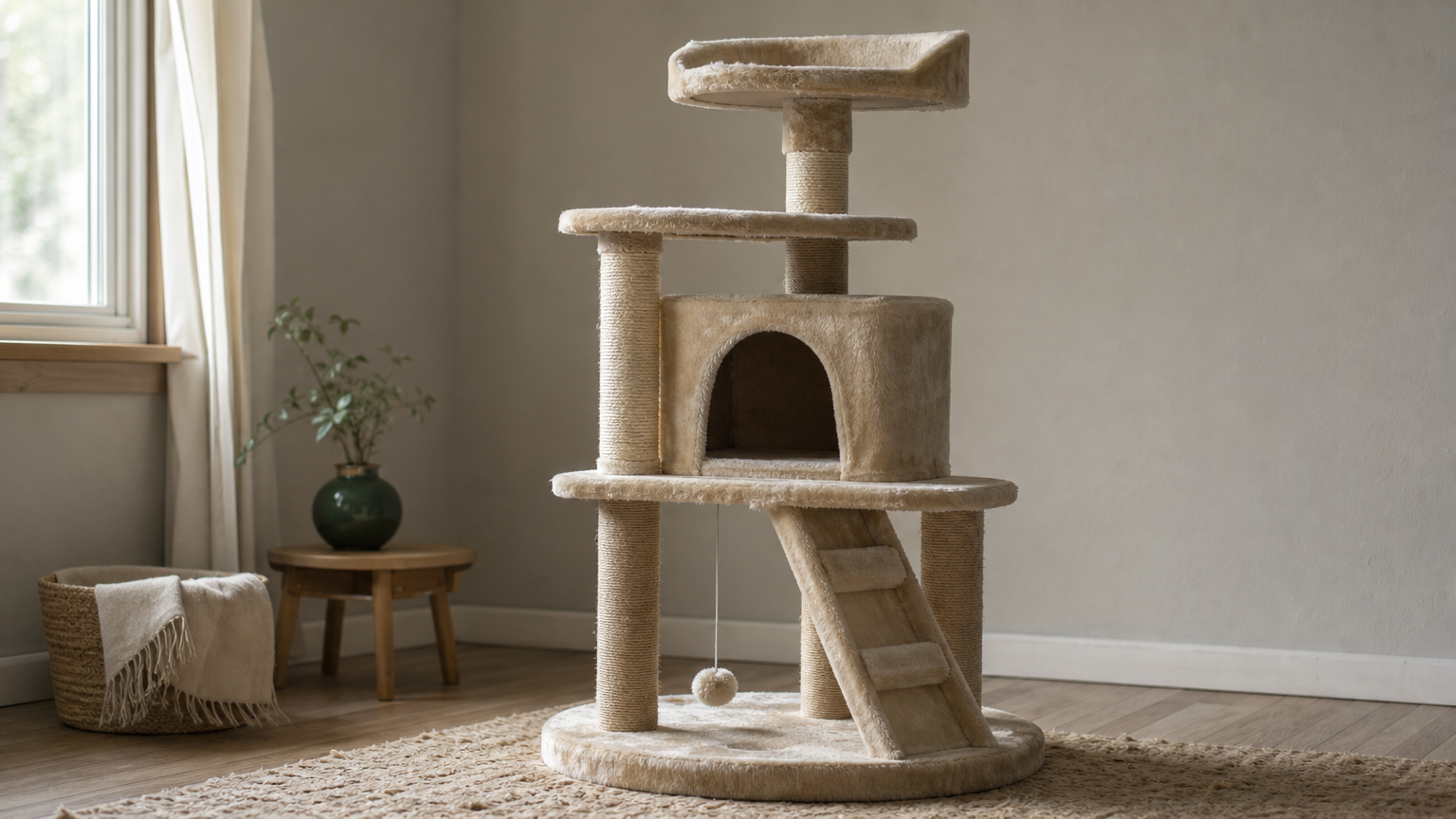
Yaheetech’s multi-level tree earns the top spot because it balances height, stability, and price better than almost anything else in this category. At around 50 inches tall, it gives most single-cat and two-cat households enough vertical territory without needing a spare room to fit it in. The plush covering feels soft enough that owners don’t mind it sitting in the living room, while the sisal-wrapped posts give cats the rough texture they actually want to dig into.
The best cat tower isn’t the tallest or the cheapest, it’s the one your cat climbs on the first day and keeps climbing on for years.
Key features
This cat tower with scratching post ships with a wide base, multiple perches, a enclosed condo for hiding, and dangling toys that encourage play near the scratch posts. The base measures over 24 inches across, which keeps it stable even when a cat leaps from the top perch.
- Four to five sisal-wrapped scratching posts
- Enclosed condo plus two to three open perches
- Plush faux-fur covering in neutral tones
- Hanging ball toy near the base
Best for
This model suits single-cat and two-cat homes in apartments or houses where floor space is limited but ceiling height isn’t. It’s also a solid pick for owners who want one cat tower and scratching post combo that handles climbing, scratching, hiding, and napping without buying separate furniture.
Price range
Expect to pay between $60 and $90 depending on the retailer and current promotions. That price point sits comfortably below custom cat furniture while still using real sisal rather than cheap carpet remnants, which is why it consistently outperforms pricier trees in durability reviews.
3. Best budget pick: Frisco faux fur cat tree
Frisco’s faux fur tree proves you don’t need to spend $80 to get a cat tower your cat will actually use. It runs smaller than the Yaheetech pick, usually around 25 to 30 inches, but it still packs in sisal-wrapped posts and a soft perch that cats gravitate toward for naps. If you’re testing whether your cat even wants a cat tower and scratching post before committing to a bigger purchase, this is the low-risk way to find out.
A budget tower with real sisal beats an expensive one wrapped in carpet.
Key features
This compact cat tree scratching post combo focuses on the essentials instead of extra bells and whistles. It’s built with a stable base, one to two sisal posts, and a cushioned top perch that most cats claim within the first day.
- One to two sisal-wrapped scratching posts
- Single elevated perch with plush cushioning
- Compact 16 to 20 inch base footprint
- Lightweight enough to move between rooms during training
Best for
Go with this model if you’re a first-time cat tower buyer, live in a small apartment, or want a secondary post for a room where your cat scratches occasionally rather than daily. It also works well as a starter cat tower with scratching post for kittens who don’t need serious height yet, or as a second unit placed near a problem couch, ideally paired with a couch cover that actually stops cat claws while you retrain your cat’s habits.
Price range
Most retailers price this tree between $25 and $40, making it one of the most affordable legitimate sisal options on the market. At that price, it’s reasonable to buy two and place them strategically near different scratching trouble spots instead of stretching your budget on a single larger tower.
4. Best for large cats: PETMAKER 6-foot cat tree
Maine Coons, big-boned rescues, and anything over 15 pounds need a cat tree with scratching post that doesn’t buckle the moment they land on the top platform. PETMAKER’s 6-foot tower solves the problem large cats create for most furniture on this list: they’re simply too heavy and too long-legged for a 40-inch tree to feel secure. The extra height also gives big cats room to fully stretch while scratching, which matters more than owners realize since a cramped post gets used half-heartedly.
A large cat on an undersized tower isn’t lounging, it’s balancing, and balancing cats give up fast.
Key features
Standing close to 72 inches, this cat tree scratching post combo reinforces its lower platforms with a wider base than most trees in its height class, which keeps the whole structure planted even when a heavy cat jumps down from the top.
- Reinforced base built for cats 15 pounds and up
- Multiple thick sisal-wrapped posts spaced across three levels
- Wide top perch built for full-body stretching
- Enclosed lower condo for large-breed cats to fully fit inside
Best for
Choose this model if you own a large or giant breed cat, a multi-cat household with at least one heavyweight, or you’ve already had a smaller tower tip over. It also works well in households where a big cat and a kitten share space, since the lower levels stay accessible while the top gives the larger cat room the smaller one won’t crowd.
Price range
Expect to spend between $80 and $110, which reflects the added lumber, base weight, and sisal length needed to support bigger cats safely. Compared to custom large-cat furniture running well over $200, this cat tower scratching post option delivers comparable stability for a fraction of the cost.
5. Best modern design: Kamaboko cotton cat tree
Most cat towers look like they belong in a garage, but the Kamaboko cotton cat tree looks like it belongs in a design magazine. Its rounded, bench-like base and natural cotton rope wrapping give it a Scandinavian feel that fits living rooms where a plush fur tower would clash. Owners who’ve avoided buying a cat tower with scratching post because every option looked bulky or cheap finally have a version that reads as furniture instead of an appliance for their cat.
Your cat doesn’t care about design, but you do, and a tower you’re proud to display is a tower that stays out where your cat can actually use it.
Key features
This cat condo with scratching post trades the usual carpet and faux fur for cotton rope and solid wood, giving it a cleaner silhouette without sacrificing scratch texture.
- Curved wooden base wrapped in natural cotton rope
- Two to three scratching posts doubling as structural legs
- Minimalist top perch with a low-profile cushion
- Neutral wood tones that match mid-century and Scandinavian decor
Best for
Pick this model if you care about how your living room looks and refuse to buy furniture that clashes with everything else in the room. It’s a strong fit for single-cat households in apartments or condos, since the design leans compact rather than sprawling. It’s not the right choice for households needing serious height or multiple perches, since the modern shape prioritizes looks over square footage.
Price range
This tree cat scratching post design typically runs between $70 and $100, a slight premium over similarly sized plush options. You’re paying for the aesthetic and the cotton rope, which holds up nearly as well as sisal while looking far more polished on camera or in person.
6. Best for small spaces: Frisco 20-inch cat tree
Square footage shouldn’t decide whether your cat gets a scratching outlet, and Frisco’s 20-inch tree proves you can fit a legitimate cat tower with scratching post into a studio apartment or a cramped hallway corner. It skips the multi-level sprawl entirely, giving you one sturdy post and a single perch instead of stacking platforms your ceiling can’t accommodate. Renters especially like this option, since its small footprint means it won’t dominate a shared living space or block a doorway.
A tower that fits your space is worth more than a tower that fits a magazine photo.
Key features
This compact scratching post cat tree keeps everything essential and nothing extra, which is exactly why it works in tight quarters.
- Single sisal-wrapped post standing roughly 20 inches tall
- One cushioned platform sized for napping, not sprawling
- Weighted base under 14 inches wide for easy placement in corners
- Neutral fabric that blends into small living rooms and bedrooms
Best for
Apartment dwellers, dorm residents, and anyone splitting a small space with roommates will get the most out of this pick. It also earns a spot as a secondary cat tower and scratching post for owners who already have a taller tree in the living room but need something near the bed or a desk where a full-sized tower won’t fit.
Price range
Pricing typically lands between $20 and $35, making it one of the cheapest entries on this list. Given its small size, that price reflects material cost more than engineering, so don’t expect it to hold up under a large or aggressive scratcher the way bigger models on this list will.
7. Best luxury option: Lords & Labradors Helsinki tree
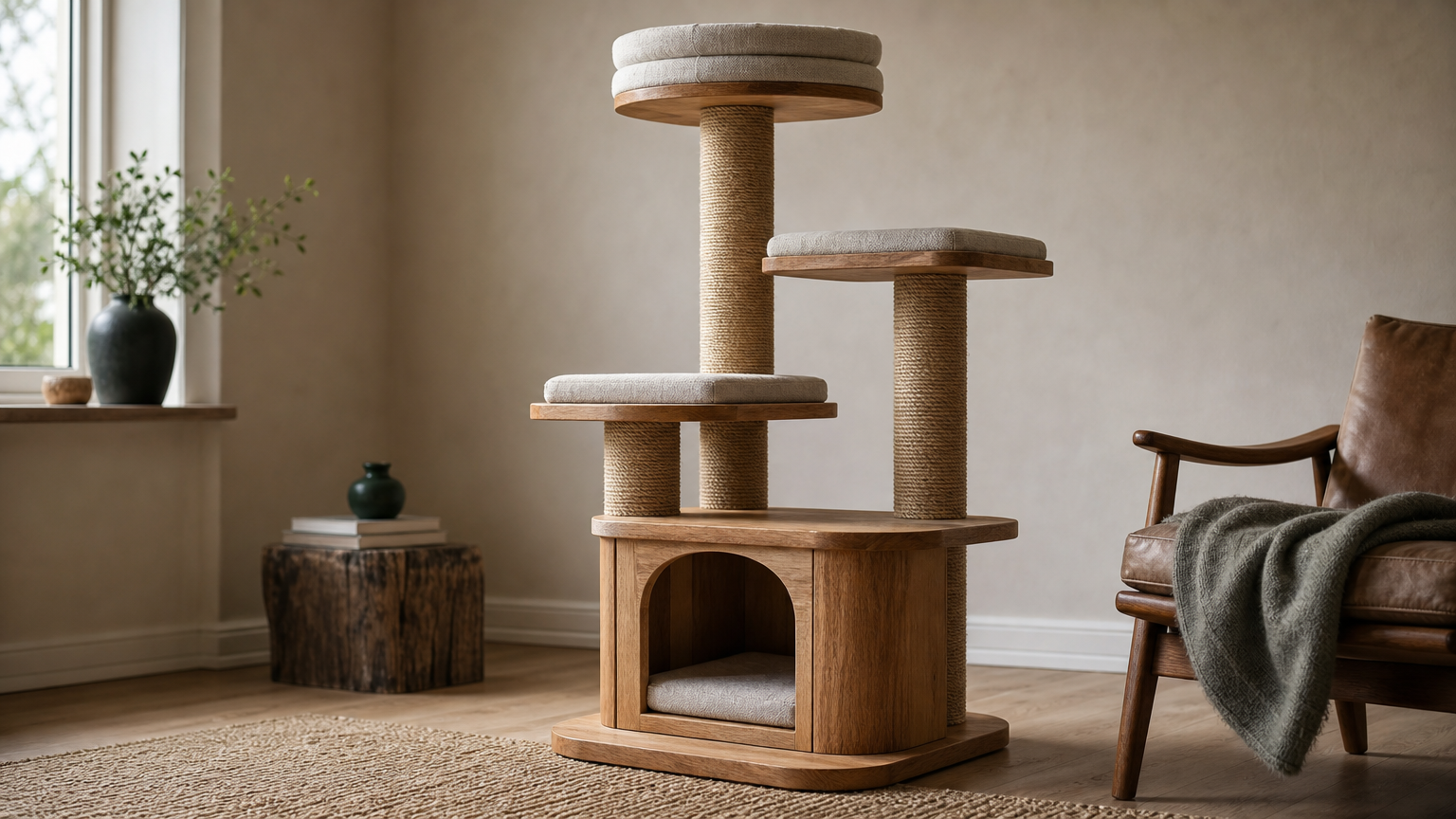
Some owners want more than a functional post, they want a cat tower with scratching post that looks like it was built by a furniture maker rather than stapled together in a warehouse. The Helsinki tree from Lords & Labradors delivers that with solid wood construction, tailored upholstery, and joinery that doesn’t wobble even after years of daily jumping. It costs more than everything else on this list, but the difference shows in the finish, the weight of the materials, and how long the sisal wrapping lasts before it needs replacing.
Luxury here isn’t about looks alone, it’s wood and sisal built to outlast a decade of daily climbing.
Key features
This cat condo scratching post setup uses real hardwood framing instead of particleboard, paired with premium sisal rope that resists fraying far longer than budget alternatives.
- Solid wood frame with hand-finished joinery
- Thick sisal rope posts rated for heavy daily use
- Tailored fabric upholstery in multiple colorways
- Reinforced platforms that support cats up to 20 pounds
Best for
Choose this model if you’ve already replaced two or three cheaper towers and you’re done buying furniture that falls apart within a year. It also suits owners furnishing a home where mismatched cat furniture would stand out, since this cat tree with scratching post is designed to sit alongside real furniture rather than apologize for existing near it.
Price range
Expect to pay between $250 and $400 depending on size and fabric choice. That’s a steep jump from the other picks here, but the hardwood construction and replaceable sisal sleeves mean you’re likely buying your last cat tower rather than your third.
8. Best wall-mounted setup: Cat wall shelf system
Sometimes a freestanding tower just isn’t an option, whether you’re renting a place with strict furniture rules or you simply don’t have floor space to spare. A wall shelf system turns unused vertical space into a climbing path, letting your cat travel up a wall instead of across your floor. It’s less a single cat tower with scratching post and more a modular setup, but the scratching component still comes built into most kits sold today.
When floor space runs out, the wall is the only direction left to give your cat.
Key features
These systems typically bolt directly into wall studs, so installation takes more effort than unboxing a standard tree, but the payoff is a completely customizable layout.
- Individual wood or carpeted shelves mounted at staggered heights
- At least one sisal-wrapped scratching post included as a climbing step
- Weight ratings per shelf, usually 15 to 25 pounds
- Modular design that lets you add or rearrange shelves later
Best for
This setup suits renters who can patch small screw holes at move-out, owners with limited floor space, and multi-cat households that need vertical territory without eating up a room’s square footage. It’s not the easiest cat scratching post cat tree alternative to install, so skip it if you’re not comfortable with a drill and a stud finder, or if your landlord won’t allow wall mounting at all.
Price range
A basic three to five shelf kit runs $40 to $80, while larger systems with six or more shelves and multiple posts can climb toward $150. Compare that to the U.S. Consumer Product Safety Commission’s general mounting safety guidance before installing anything into drywall alone, since a shelf that pulls loose mid-jump is a real injury risk for your cat.
9. Best window perch combo: CheerPals cat window perch
Cats spend hours watching birds and cars from a windowsill, so pairing that instinct with a scratching surface makes sense. The CheerPals window perch mounts directly to your window using suction cups rated for a single cat’s weight, then adds a sisal-wrapped edge along the mounting bar so your cat scratches before settling in to watch the yard. It’s not a cat tower with scratching post in the traditional sense, but for cats who already claim the windowsill as their favorite spot, this combo redirects scratching exactly where the behavior already happens.
A scratching post placed where your cat already sits gets used more than one placed where you think it should sit.
Key features
This compact cat tree scratching post alternative trades height and floor footprint for direct window access, which matters more to some cats than climbing ever will.
- Suction-cup mount rated for cats up to roughly 15 pounds
- Sisal-wrapped scratching bar along the front edge
- Cushioned platform sized for one cat to stretch out fully
- Reinforced straps as backup support beyond the suction cups
Best for
Go with this pick if your cat already spends most of the day parked on a windowsill, since it turns existing behavior into a scratching opportunity instead of asking your cat to learn a new spot. It also works well in small apartments where a full cat tower and scratching post won’t fit, and as a secondary perch for households that already own a taller tree elsewhere in the home.
Price range
Expect to pay between $30 and $50, making it one of the more affordable entries on this list. Check the suction cup weight rating against your own cat’s size before buying, and always add the backup straps if the kit includes them.
10. Best outdoor catio: Kitty City outdoor cat furniture
Outdoor cats need a scratching setup that survives weather, and Kitty City’s outdoor line builds a cat tower with scratching post using weather-resistant materials instead of the plush fabrics you’d find indoors. It’s meant for a screened porch, a catio, or a covered patio where your cat gets fresh air without free-roaming risk. The sisal posts here use a coated wrap that resists mildew, which matters since regular indoor sisal rope turns moldy fast once it gets damp.
A tower that can’t handle rain isn’t an outdoor tower, it’s an indoor tower left outside by mistake.
Key features
This cat tower and scratching post setup swaps particleboard for weather-treated wood and plastic components, so it won’t warp or swell after a few humid weeks.
- Weatherproof wood and plastic construction rated for covered outdoor use
- Mildew-resistant sisal wrap on all scratching posts
- Elevated platforms for bird-watching and sun-napping
- Drainage gaps built into the base to prevent water pooling
Best for
Choose this model if you’ve built or are planning a catio, or if you keep a covered porch your cat already treats as part of its territory. It also suits owners in warmer climates where cats spend real time outside daily, since a standard indoor cat condo scratching post breaks down fast once exposed to sun and moisture. Skip it if your cat stays strictly indoors, since the weatherproofing adds cost you won’t need.
Price range
Most retailers price this line between $70 and $120 depending on height and platform count. That’s a fair trade for materials that won’t rot or mold within a season, especially compared to replacing an indoor tower ruined by one rainy week.
11. Best adjustable design: Coziwow floor-to-ceiling tree
Some ceilings sit at 8 feet, others stretch to 10 or 12, and a fixed-height tower either leaves awkward gaps or doesn’t reach far enough to feel secure. Coziwow’s floor-to-ceiling tree solves that with a tension rod system that adjusts to fit your actual room instead of forcing your room to fit the tower. Once you extend the pole and lock it against the ceiling, the whole structure gains stability that a freestanding base alone can’t match, since the ceiling itself becomes part of the support system.
A tower braced against your ceiling can’t tip, no matter how hard your cat launches off the top perch.
Key features
This cat tower with scratching post design uses a telescoping center pole instead of a fixed frame, which is what lets it fit rooms with different ceiling heights.
- Adjustable pole extending to fit ceilings between roughly 7.5 and 9 feet
- Multiple sisal-wrapped sections along the full length of the pole
- Two to three perches plus a hammock or condo attachment
- Ceiling-brace mechanism that adds stability beyond a standard base
Best for
This model suits owners with high ceilings who want maximum vertical territory without a base wide enough to eat up floor space. It’s also a strong pick for multi-cat households where several cats need to climb and scratch at once, since the tension-mounted design holds steady even under repeated jumping. Measure your ceiling height carefully before ordering, since an incorrect fit means the pole either won’t reach or won’t lock in place.
Price range
Expect to pay between $90 and $140 depending on the pole length and number of accessories included. That price sits above most standard freestanding trees, but you’re paying for a stability method that a wider base alone can’t replicate, especially in homes with multiple cats sharing one climbing structure.
12. Best for multi-cat homes: PETMAKER 3-tier cat tower
Multiple cats sharing one climbing structure need separate scratching zones, not just separate perches, or you’ll end up with territorial standoffs at the base. PETMAKER’s 3-tier tower spaces its posts and platforms wide enough that two or three cats can climb, scratch, and nap without constantly bumping into each other. Unlike a single-pole design, this cat tower with scratching post setup spreads its footprint horizontally as well as vertically, giving cats room to claim their own level without feeling cornered.
Multi-cat households don’t need a taller tower, they need enough separate space that no cat has to share.
Key features
This cat tower and scratching post combo prioritizes width and multiple access points over sheer height, which matters more once you’re furnishing for three or more cats.
- Three distinct tiers with separate entry points to each level
- Four sisal-wrapped posts positioned so no two cats compete for the same post
- Wide, reinforced base rated for combined weight well over 30 pounds
- Enclosed condo plus open perches to satisfy hiders and watchers alike
Best for
Go with this model if you’re managing a household with three or more cats, especially if you’ve noticed one cat guarding the only scratching post in the house. It also suits foster homes and multi-pet families where cats rotate through the space at different times of day, since the tiered layout means nobody has to wait their turn.
Price range
Expect to pay between $65 and $95, which is reasonable given the extra material needed to widen the base and add a fourth post. Compared to buying two separate single-cat towers, this cat condo scratching post setup delivers more usable space per dollar.
13. FAQs about cat towers with scratching posts
How many scratching posts does my cat actually need?
One dedicated post per cat, plus one extra, is the standard rule vets and behaviorists recommend. If you’re managing a cat tower with scratching post in a two-cat home, look for a model with at least three separate posts so nobody has to wait or compete.
Will my cat use the tower instead of my furniture?
Usually, but only if placement matches your cat’s habits and you understand what drives your cat to scratch the couch in the first place. Cats gravitate toward posts near windows, doorways, or the exact couch cushion they already scratch, so drag the tower there first, and try rubbing catnip on the post before assuming your cat rejected it.
Redirect the behavior to where it already happens, and the couch stops being the target on its own.
Sisal or carpet, which scratch material lasts longer?
Sisal rope and sisal fabric hold up far longer than carpet, which frays and mats within months of daily use. Nearly every cat scratching post cat tree on this list uses sisal for that reason, and it’s worth paying a little more to avoid replacing carpet-wrapped posts twice a year.
Do kittens need a different tower than adult cats?
Kittens do best with shorter towers around 20 to 30 inches, since tall multi-level trees can feel intimidating or unsafe before they’ve built confidence jumping. Once your kitten reaches four to six months old, most households size up to a taller cat tree with scratching post without issue.
How long should a quality cat tower actually last?
A well-built tower with a solid base and real sisal should hold up for three to five years of daily use before the posts need re-wrapping. Cheaper carpet-based towers, by contrast, often show wear within the first year, which is where the price difference across this list starts to make sense.
Giving your cat a place to climb and scratch
A good cat tower with scratching post solves the scratching problem by giving your cat something better than your couch, not by punishing the instinct itself. Whether you land on the budget Frisco pick, the heavy-duty PETMAKER for large cats, or a wall-mounted system for a tight apartment, the real win comes from matching the tower to your space, your cat’s size, and how many cats actually share the home.
Buying the right furniture is half the job. Training your cat to prefer it, especially if the couch has years of habit built up, takes a bit more strategy than just placing a post in the corner and hoping. If your cat still drifts back to the furniture after you’ve set up a great tower, a structured, day-by-day redirection plan can close that gap fast. Get the complete cat training system with free bonus guides and have your cat scratch-free within a week, backed by a 60-day money-back guarantee.