You bought the scratching post. You set it up right next to the couch your cat keeps shredding. And your cat walked past it like it wasn’t even there. Sound familiar? Using catnip for scratching post training is one of the fastest ways to fix that, but only if you apply it the right way.
Most owners sprinkle a pinch of catnip on top once and give up when nothing happens. The trick isn’t just adding catnip, it’s where and how often you apply it during the first two weeks, paired with placement that matches your cat’s natural scratching spots. Fresh catnip, dried catnip, and catnip spray all work differently, and timing matters just as much as the product you choose.
In this guide, you’ll get a step-by-step method for applying catnip so your cat actually associates the post with pleasure instead of ignoring it. This same redirection logic is at the core of Scratch-Free in 7 Days, the guide Dr. Rachel Martinez built around positive, science-backed habit change rather than punishment. Think of catnip as one tool in that toolkit, and this article as the piece that gets your post noticed in the first place.
Why catnip helps your cat love its scratching post
The reasons cats scratch furniture have nothing to do with spite toward your couch. They’re marking territory with scent glands in their paws, stretching tight muscles, and shedding the outer sheath of their claws. Catnip doesn’t teach your cat to scratch, it redirects an instinct your cat already has toward the surface you want. That distinction matters, because it’s why a post with the right catnip application works faster than a bare one, and why understanding the mechanism helps you apply it correctly instead of guessing.
The chemistry that makes catnip work
Catnip contains a compound called nepetalactone, which binds to receptors inside a cat’s nose and triggers a response in the brain similar to how pheromones work. Researchers at Cornell University’s College of Veterinary Medicine note that this reaction produces short bursts of euphoria, rolling, rubbing, and increased activity, all of which make a cat more likely to interact physically with whatever surface carries the scent. When you rub catnip into the sisal rope or cardboard of a scratching post, you’re not masking the material, you’re layering a scent your cat is biologically wired to seek out on top of a surface built for scratching.
A scratching post only becomes a habit once your cat’s own instincts, not your preferences, point them toward it.
Why some cats respond and others don’t
Not every cat reacts to catnip the same way, and that’s worth knowing before you assume the product failed. The response is genetic and shows up in roughly 50 to 70 percent of cats, according to veterinary behavior research summarized by the ASPCA. Kittens under three months rarely respond at all, since the sensitivity typically develops with age. If your cat ignores a catnip-infused scratching post, you’re not doing something wrong, you may just have a cat whose genetics or age put them outside that response window.
| Cat group | Typical catnip response |
|---|---|
| Adult cats (most breeds) | 50-70% show a strong reaction |
| Kittens under 3 months | Little to no reaction |
| Senior cats | Response often weakens with age |
| Non-responders | Roughly 1 in 3 cats show no reaction at all |
If your cat falls into that non-responder group, don’t force more catnip on the post hoping for a delayed reaction. Move straight to the alternatives and placement strategies covered later in this guide.
How the scent turns into a habit
Once a cat has that first positive experience with catnip on a post, the post itself starts to carry meaning. Cats build strong scent associations, and a few sessions of pleasurable rolling and clawing at a catnip-treated post is often enough to make the post a preferred scratching spot, even after the scent fades. This is the same redirection principle behind Scratch-Free in 7 Days: you’re not suppressing the scratching instinct, you’re giving it a better outlet and letting repetition do the rest. Catnip just speeds up that first connection, which is why timing and placement in the steps ahead matter as much as the catnip itself.
Think of catnip as the icebreaker, not the whole relationship. Your cat still needs the post to feel physically satisfying, positioned somewhere they already want to be, and reinforced with attention when they use it. The next six steps walk through exactly how to stack those factors so the attraction catnip creates actually sticks.
Step 1. Choose the right catnip for the job
Not all catnip works the same way on a scratching post, and picking the wrong form is why some owners think their cat is a non-responder when the product itself is the problem. Dried catnip leaf, fresh catnip, and catnip spray all carry nepetalactone, but the concentration and how long it lasts on sisal or cardboard vary a lot. Before you buy anything, decide whether you want a strong one-time hit to introduce the post or a lighter scent you can top up every few days without soaking the material.
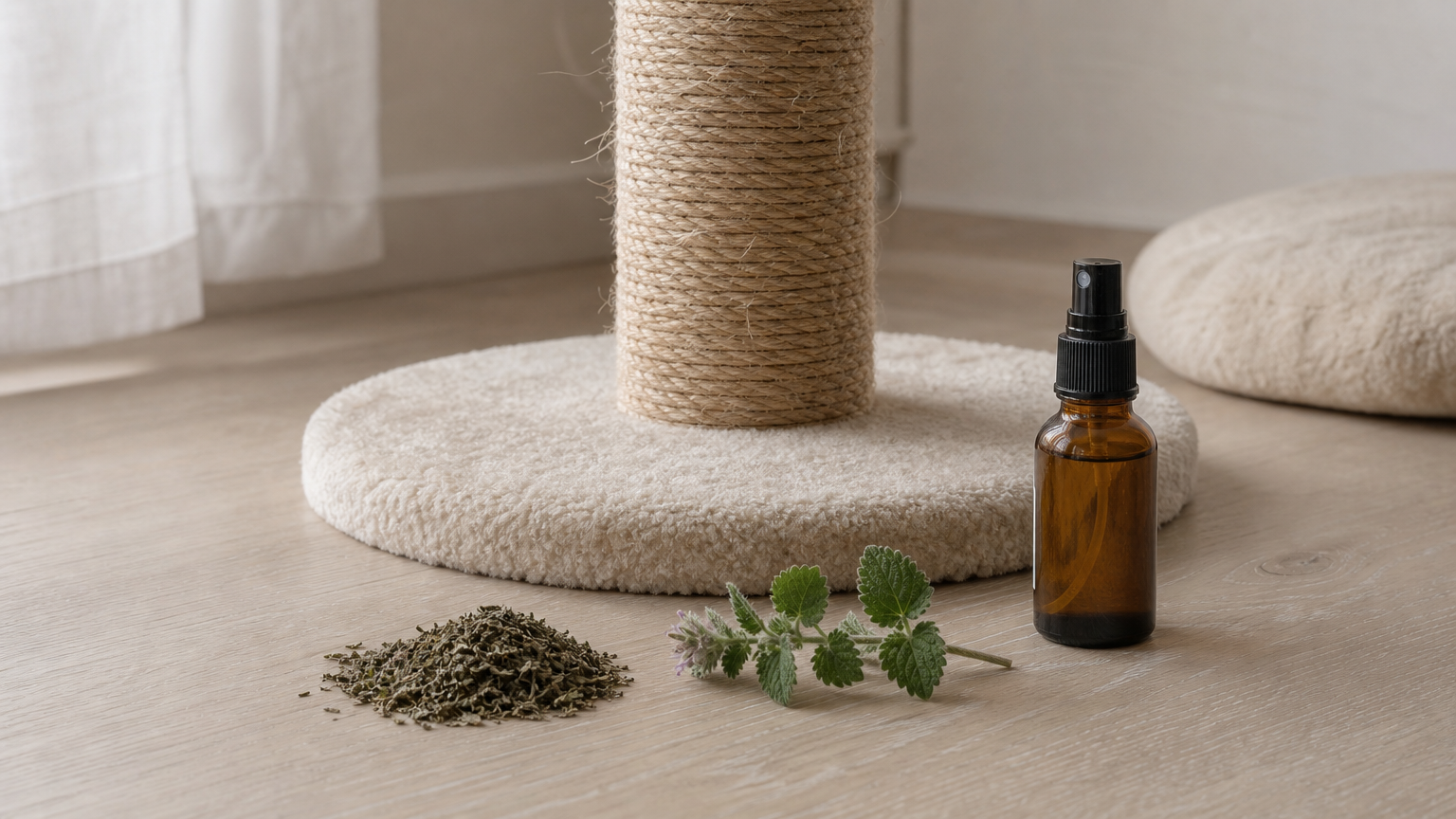
The right catnip form matters less than picking one that stays potent long enough for your cat to build the habit.
Dried, fresh, or spray: which form to buy
Each format has a job it does best, and knowing the tradeoffs upfront saves you from buying three products before you find one that works.
| Form | Potency | Best use | Downside |
|---|---|---|---|
| Dried catnip leaf | High, if fresh | Rubbing directly into sisal rope | Loses potency fast once opened |
| Fresh catnip (growing or cut) | Highest | Crushing leaves onto the post | Short shelf life, needs a plant |
| Catnip spray | Low to moderate | Quick daily refresh | Often diluted, weaker effect |
| Catnip-infused toys/posts | Moderate, pre-applied | Buying instead of applying | Scent fades within weeks |
If you’re shopping for a catnip-infused scratching post rather than applying your own, check the product description for how the catnip is delivered. Posts with catnip baked into the sisal fiber during manufacturing tend to hold scent longer than ones with a light spray coating added after the fact.
Check potency and freshness before you buy
Dried catnip loses potency within months of being opened, so a bag that’s been sitting on a store shelf for a year may barely register with your cat. Look for these signs before you commit to a product:
- Color: a vibrant green, not faded gray-brown
- Smell: a sharp, minty scent you can detect through the packaging
- Packaging: resealable bags or airtight containers, not thin plastic pouches
- Ingredient list: 100% catnip, with no fillers or artificial additives
Growing your own catnip plant solves the freshness problem entirely and gives you a renewable supply for reapplication. If that’s not practical, buy dried catnip in small bags rather than bulk, since you’ll use it up before it fades and won’t be tempted to over-apply just to use what you paid for.
Step 2. Apply catnip to make the post irresistible
Getting the catnip onto the post matters more than which brand you bought. How you apply catnip determines whether your cat notices it at all, and most owners undersell the post by treating application like an afterthought instead of the main event. A light dusting on top of the post rarely reaches the fibers your cat actually claws into, so the scent disappears before it does any work.
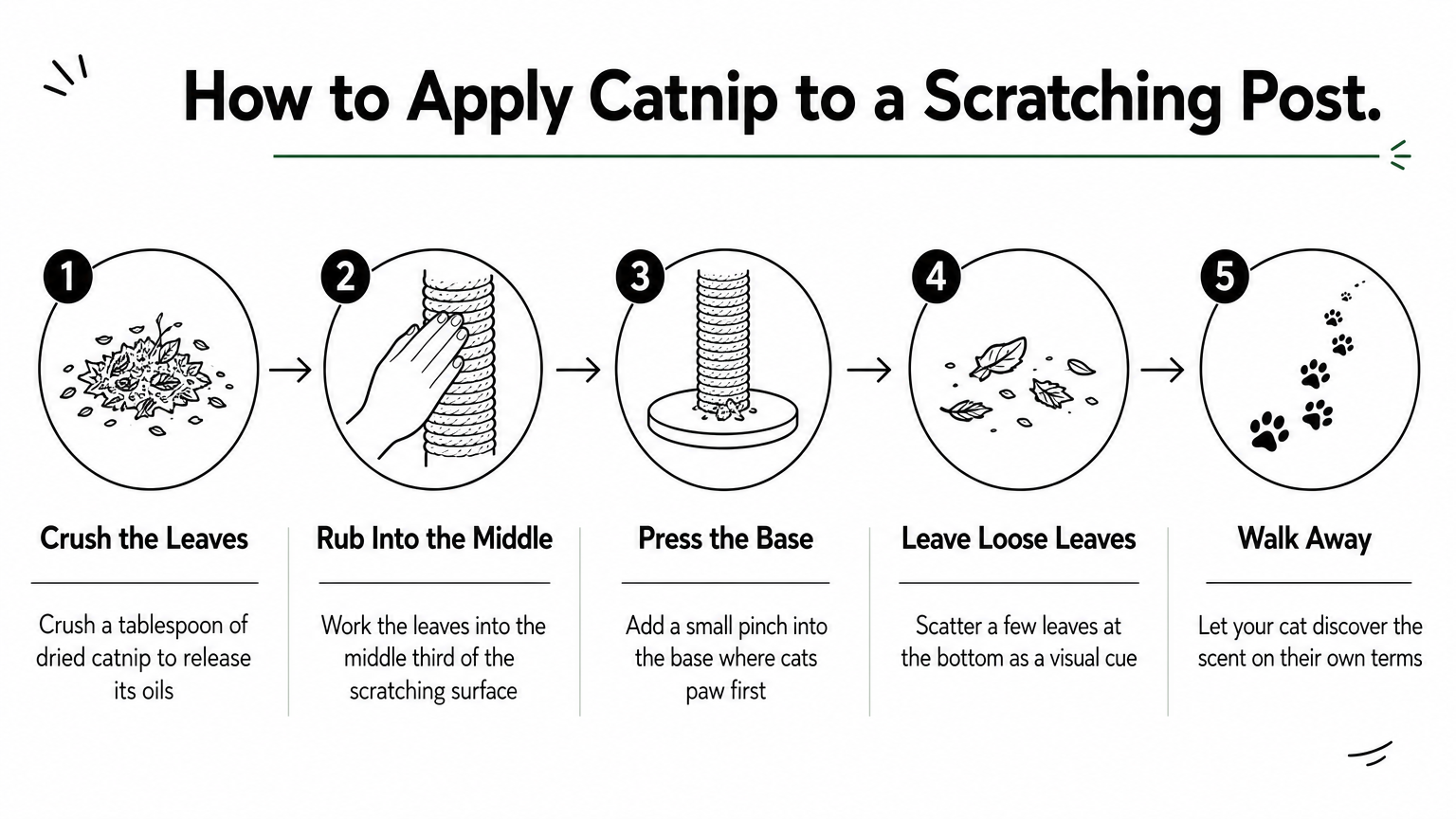
Rub it into the material, don’t just sprinkle it on top
Crush the dried leaves between your fingers first to release the oils, then work the powder directly into the sisal rope, cardboard grooves, or carpet fibers with your hand. This gets nepetalactone into the texture your cat will be scratching, not just resting on the surface where it blows away or falls off.
A post that smells like catnip on the surface loses that scent in a day, one that’s rubbed into the fibers holds it for a week.
Follow this sequence the first time you set up a catnip-infused scratching post:
- Crush a tablespoon of dried catnip between your palms to release the oils.
- Rub the crushed leaves firmly into the vertical scratching surface, focusing on the middle third where cats tend to stretch upward.
- Press a small pinch into the base too, since cats often paw at the bottom before climbing higher.
- Leave a few loose leaves at the base as a visual and scent cue.
- Walk away and let your cat discover it on their own terms.
Skip the spray if you’re using dried leaf
Combining a spray on top of already-rubbed dried leaf usually just wastes product. Spray works well as a standalone option for quick refreshes, but layering it over dried leaf you’ve already worked into the fibers doesn’t add much scent strength, since the sisal can only hold so much of the compound at once. Pick one method per session and stick with it.
Let your cat find it instead of forcing contact
Owners often make the mistake of picking up their cat’s paws and dragging them across the treated post, thinking that speeds up the association. Resist that urge. Cats build positive associations faster when they choose to investigate the scent themselves rather than being physically guided to it, and forced contact can create the opposite reaction, an aversion to a post they now associate with being handled against their will. Set the post up, apply the catnip, and step back. If the concentration and rubbing were done right, curiosity does the rest within the first hour.
Step 3. Place the post where your cat will find it
Catnip pulls your cat toward the post, but placement decides whether that pull turns into a habit. A perfectly treated post shoved in a spare bedroom or behind a curtain gets ignored no matter how much nepetalactone you rub into it, because your cat never walks past it long enough to notice. The goal is to put the post somewhere your cat’s daily path already crosses, not somewhere that’s convenient for your decor.
A catnip-treated post only works if your cat trips over it during their normal routine, not if you hide it out of the way.
Start where the damage already happened
Your cat has already told you where they want to scratch: look at the couch arm, the carpet edge, or the doorframe they’ve been shredding. Position the new post within a few feet of that exact spot first, since your cat’s scent marking behavior means they’ve already claimed that territory as a scratching zone, and consider a furniture protector for scratching to shield the couch while the post takes over. Once the post has held its ground for a week or two and your cat is using it consistently, you can inch it toward a spot you’d prefer, moving it no more than a foot or so every few days so the scent trail stays intact.
Match the post to your cat’s routine, not your floor plan
Cats tend to scratch right after waking up and near entryways where they reinforce territory boundaries, so those are the two placements that pay off fastest.
- Near the sleeping spot: cats stretch and scratch immediately after a nap, so a post within a few steps of their bed catches that instinct in the moment.
- By high-traffic entryways: hallways, the base of stairs, or the spot by the front door where your cat greets you all get frequent scent-marking behavior.
- Away from the litter box: cats don’t like mixing scratching zones with elimination zones, so keep several feet of distance.
- Not tucked in a corner or closet: low-visibility spots get skipped even with catnip applied, since your cat has to actively seek them out instead of encountering them naturally.
Multi-cat households need more than one post
If you’ve got more than one cat, one treated post usually isn’t enough, since scratching also marks territory and a single post can turn into a contested resource. Place a catnip-infused scratching post in at least two separate rooms or zones so each cat has access without waiting their turn or getting chased off by a more dominant housemate. This matters even more in homes where cats already compete over resting spots or feeding areas, since adding competition over the scratching post just recreates the tension you’re trying to fix. Once placement is solid, the next step is making sure your cat’s actual scratching behavior gets rewarded every time it happens.
Step 4. Reward your cat for every scratch
Catnip gets your cat to the post, but positive reinforcement is what keeps them coming back once the novelty of the scent wears off, the same principle behind practical training tips that stop couch scratching. Every time your cat scratches the treated post instead of the couch, you’ve got a small window to reinforce that choice, and skipping that step is why some cats revert to old habits within a month even after a strong catnip introduction. Think of catnip as the invitation and reinforcement as the reason your cat accepts it again tomorrow.
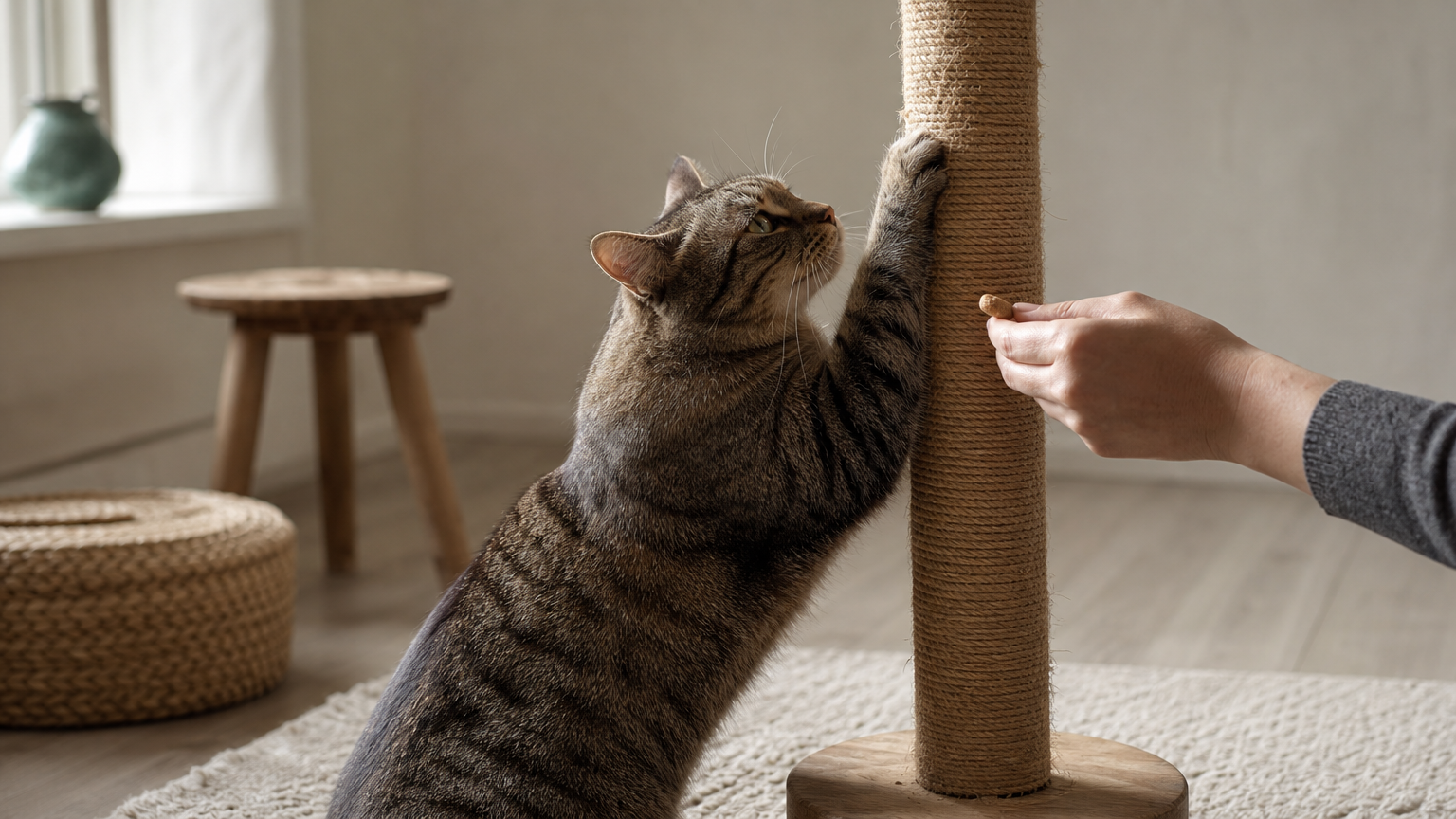
A cat that gets rewarded for scratching the post learns faster than one that’s just left to figure it out alone.
Catch the behavior in the moment
Rewards only work if they land within a few seconds of the scratch, since cats don’t connect a treat to an action that happened five minutes earlier. Watch for the moments your cat naturally approaches the post, especially right after waking up or when they’re stretching near it, and be ready to respond immediately. Praise in a calm, happy tone, offer a small treat, or give a few strokes right at the post itself so the reward and the location stay linked in your cat’s mind.
- Verbal praise: a soft, upbeat tone the instant claws touch the post
- Small food reward: one or two pieces of a treat your cat already loves, not a whole handful
- Physical affection: a scratch behind the ears while they’re still at the post, not after they’ve walked away
- Play reward: a few seconds with a wand toy near the post to extend the positive association
What kind of reward works best
Different cats respond to different incentives, so it’s worth testing which one gets the fastest reaction before settling into a routine.
| Reward type | Best for | Speed of association |
|---|---|---|
| Food treats | Food-motivated cats | Fastest |
| Praise/voice | Cats bonded closely to their owner | Moderate |
| Physical touch | Affectionate cats | Moderate |
| Play/toy | High-energy or younger cats | Fast |
Food treats tend to build the association quickest because the reward is immediate and unambiguous, but pair it with praise so your cat eventually responds to your voice alone once the treats taper off.
Timing matters more than the treat itself
Rewarding too late, even by a minute, teaches your cat nothing about the post and just becomes a random treat delivery they don’t connect to scratching. Set yourself up to catch it by keeping treats near the post’s location for the first two weeks, so you’re never scrambling to find one while the moment passes. Understanding this timing window is also central to the redirection method in Scratch-Free in 7 Days, where consistent, immediate reinforcement replaces punishment entirely during the retraining period.
Step 5. Refresh the catnip to keep interest alive
Catnip potency fades fast once it’s exposed to air, and a post that smelled irresistible on day one can go stale by day ten if you never touch it again. Refreshing the catnip on a regular schedule is what turns a one-time novelty into a lasting habit, since your cat’s interest naturally dips as the scent weakens, right around the point where the reinforcement from Step 4 needs to take over anyway. Skipping this step is one of the most common reasons a catnip-infused scratching post gets ignored after the first week even though it worked great at first.
A post that smelled great on day one and never gets refreshed will feel forgotten by day ten.
How often to reapply
Dried catnip rubbed into sisal or cardboard usually holds noticeable scent for five to seven days before it needs a top-up, though heat, humidity, and how often your cat rubs against the post all speed that timeline up. Fresh catnip loses potency even faster, often within two to three days, so it needs more frequent attention if that’s your preferred form.
| Catnip form | Reapply every | Signal it’s fading |
|---|---|---|
| Dried leaf, rubbed in | 5-7 days | Cat sniffs but doesn’t roll or claw |
| Fresh catnip | 2-3 days | Leaves visibly wilt or dry out |
| Catnip spray | 2-4 days | Scent undetectable to you up close |
Rotate the spot you apply it
Applying fresh catnip to the exact same worn patch every time can dull your cat’s response over time, since the fibers there may already be saturated with old residue and dust. Shift your rubbing to a slightly different section of the post each refresh, alternating between the middle and base, so your cat keeps encountering a scent that feels new rather than a stale layer on top of old catnip.
Watch for waning interest before it becomes a habit break
Signs your cat’s interest is fading show up before they abandon the post entirely, and catching them early means you refresh before old scratching habits creep back in.
- Sniffing the post but walking away without scratching
- Shorter scratching sessions than during the first week
- Returning to old scratching spots on furniture nearby
- No rolling or rubbing behavior at the post anymore
Treat these as your cue to reapply immediately rather than waiting for a fixed calendar date. Once refreshing becomes routine, most owners find they only need to think about it once a week, and by then the reinforcement habits from Step 4 are usually strong enough to carry the post the rest of the way on their own.
Step 6. Troubleshoot a cat that ignores the catnip
Sometimes you’ve followed every step and your cat still walks past the post like it’s invisible. Before you assume the whole method failed, run through a short checklist, since most catnip failures trace back to one fixable mistake rather than a cat that simply doesn’t care about scratching.
Rule out the usual suspects first
Work through these possibilities in order, since fixing the wrong one wastes time you could spend on the actual problem.
- Stale catnip: if the bag has been open for months, the nepetalactone may already be gone. Test a fresh pinch on a cotton ball first to see if your cat reacts at all.
- Too little product: a light dusting on top rarely reaches your cat’s nose. Go back to Step 2 and rub it firmly into the fibers.
- Wrong placement: a post in a spare room your cat never enters won’t get discovered no matter how strong the scent is. Revisit Step 3 and move it closer to the damaged furniture.
- Age: kittens under three months typically show no response yet, so patience matters more than more catnip.
- Individual genetics: roughly a third of cats simply don’t carry the gene that triggers a response, and no amount of reapplication will change that.
If your cat sniffs and walks away every time, the problem is almost always the catnip’s freshness or the post’s location, not your cat.
When your cat is a genuine non-responder
Once you’ve ruled out staleness, quantity, and placement, and your cat still shows zero interest across several fresh applications, you’re likely dealing with a non-responder. That’s not a training failure. It just means catnip isn’t the lever that’s going to work for this particular cat, and continuing to pile more onto the post won’t change the genetics behind the reaction. The good news is catnip was never the only tool available, and the next section walks through alternatives like silver vine and valerian root that trigger a response in many cats who ignore catnip entirely.
Watch for behavioral, not just scent, barriers
Sometimes the catnip is fine, but something about the post itself is putting your cat off. A wobbly base, a scratching surface that’s too short for a full stretch, or a spot too close to a noisy appliance can override even the strongest scent. Check that the post is tall enough for your cat to fully extend and stable enough that it doesn’t tip when they dig in, since a post that shakes or falls once often gets avoided permanently regardless of how it smells, and if yours fails that test, see which scratching posts cats actually use.
Catnip alternatives and safety notes
When your cat turns out to be one of the roughly one in three non-responders, catnip isn’t the end of the road, it’s just the wrong key for that particular lock. Silver vine, valerian root, and honeysuckle wood all trigger a similar euphoric response through different compounds, and research reviewed by Cornell’s Feline Health Center suggests silver vine actually attracts an even higher percentage of cats than catnip does, including many cats that show zero interest in nepetalactone.
If catnip doesn’t work, silver vine usually will, since it reaches cats through a completely different chemical pathway.
Comparing the alternatives
Each alternative comes with its own strength and application method, so it’s worth trying more than one before assuming your cat is unmoved by scent-based attractants entirely.
| Alternative | Response rate | Best application |
|---|---|---|
| Silver vine | Higher than catnip in many studies | Powder rubbed into fibers, or dried gall fruit rubbed directly on post |
| Valerian root | Moderate, different response profile | Sprinkled dry, less messy than catnip |
| Honeysuckle wood | Moderate | Wood shavings or sticks attached to the post |
| Catnip | 50-70% of adult cats | Rubbed into fibers or sprayed |
Apply silver vine or valerian the same way you’d apply dried catnip: rub it into the scratching surface rather than dusting the top, and give it a few days before judging whether your cat responds.
How much is safe, and what to watch for
Catnip and its alternatives are non-toxic and non-addictive, and there’s no risk of your cat overdosing on scent alone. Ingesting small amounts of dried leaf that falls off the post is generally harmless too, though a cat that eats a large quantity may show mild stomach upset like vomiting or loose stool. Overuse doesn’t make the effect stronger, it just wastes product, since a cat’s response peaks and then resets after roughly ten to fifteen minutes regardless of how much catnip is present.
Skip catnip and its alternatives entirely if:
- Your cat has previously shown digestive upset after exposure
- You’re using it around a pregnant cat, since some vets advise caution though evidence of harm is limited
- Your veterinarian has flagged a specific sensitivity during a checkup
Outside of those cases, catnip, silver vine, and valerian are safe tools you can rotate freely, and mixing them over time keeps the post interesting even for cats that respond well to all three.
Turning the post into your cat’s favorite spot
Getting catnip for scratching post training right comes down to layering the right pieces: fresh product rubbed into the fibers, placement near your cat’s real routine, quick rewards, and regular refreshing before interest fades. Skip any one of those and the post turns into another piece of ignored furniture. Follow all six steps and you’re not just masking a scratching problem, you’re rewiring where your cat’s instinct naturally lands.
Catnip gets your cat’s attention, but lasting change comes from consistent, positive redirection over time, not a single lucky application. That’s exactly the approach behind Scratch-Free in 7 Days, Dr. Rachel Martinez’s day-by-day system for retraining scratching habits without punishment or declawing. If your couch is still taking the hits, read our full review of Scratch-Free in 7 Days to see how the day-by-day method works, and give your cat a better outlet this week instead of another year of shredded arms.