Your couch has claw marks running down the arm again, and you’re done pretending it’s fine. Whether you’re renting and worried about your deposit or just tired of watching a $1,200 sofa turn into a scratching post, you need a cat furniture protector scratching solution that actually holds up, not another spray bottle promise that fizzles out in a week.
The good news: there are real products built for this exact problem, from clear vinyl shields to woven sisal guards to heavy-duty couch covers designed specifically to survive claws. Below, you’ll find eleven options tested against actual scratching behavior, covering everything from budget corner guards to furniture protectors from cat scratching that double as decor.
But covering the damage only treats the symptom. Cats scratch because it’s instinct, not spite, and the real fix is redirecting that instinct somewhere better. We built "Scratch-Free in 7 Days" for exactly that reason, using a science-backed, humane method instead of deterrents your cat learns to ignore. Use this list to stop the bleeding on your furniture now, then pair it with training your cat to scratch the right spot for good.
1. A 7-day training method that stops scratching at the source
Every product on this list has one job: keep claws off your furniture. But none of them address why your cat is scratching in the first place. That’s where "Scratch-Free in 7 Days" comes in. It’s not a couch cover or a spray, it’s a behavioral program built by a certified feline behaviorist who lived through the same shredded-armrest nightmare you’re dealing with now. Instead of blocking access to your sofa, it retrains your cat’s instinct to land somewhere else entirely.
How it works
The guide walks you through a day-by-day blueprint across six modules, starting with the actual science of why cats scratch (it’s territory marking and claw maintenance, not revenge) and ending with placement and reinforcement strategies that stick. You get four bonus guides too: building your own scratching post, repairing furniture that’s already damaged, a fast-track plan for kittens age 8 to 16 weeks, and a module specifically for stress-related scratching, which is common in multi-cat households. Most owners report their cat noticeably shifting away from furniture within the first week, which lines up with how quickly cats form new habit loops when the right post is placed at the right moment.
A cover hides the damage. A trained habit prevents it.
Who it’s for
This method suits owners who are done with band-aid fixes and want to protect furniture from cat scratching permanently rather than every time they replace a worn-out cover. It’s especially useful for renters worried about security deposits, since it eliminates the damage instead of masking it under a throw blanket. Multi-cat households benefit from the dedicated section on managing competing scratching instincts, and anyone raising a kitten gets a head start with the fast-track module before bad habits even form. If you’ve already tried deterrent sprays or double-sided tape and watched your cat scratch right through the routine anyway, this is built for exactly that frustration, and it pairs well with cat behavior training that stops furniture scratching.
Price range
The guide is a one-time digital purchase, currently discounted from $121 to $19 as part of a limited-time offer, with instant download and no recurring subscription. It comes with a 60-day money-back guarantee, so if your cat hasn’t shifted behavior within two months, you get your money back with no questions asked. Compared to replacing a couch or repeatedly buying covers and tape that get shredded within weeks, it’s the cheapest long-term fix on this list. You can grab the full program directly through Scratch-Free in 7 Days.
2. Clear vinyl and plastic furniture guards
Sometimes you just need a physical barrier between claws and cushions while you work on the deeper training. Clear vinyl and plastic guards are rigid or semi-rigid sheets that stick to or drape over the arms, corners, and back panels of your couch, acting as a furniture protector for cat scratching that’s nearly invisible from across the room. They’re one of the most common quick fixes people grab before they realize covering the problem doesn’t solve it.
How it works
Most guards use adhesive strips or tuck-and-drape edges to stay in place over the sections your cat targets most, usually the arms and front corners. The plastic surface itself is unpleasant to claw against, so cats lose interest fast, and the material is tough enough to resist punctures from repeated attempts. Brands like Sofa Shield and Purrfect View sell precut panels sized for standard couch arms, so you’re not stuck cutting sheet plastic yourself.
Clear guards buy you time, they don’t buy you a solution.
Who it’s for
These guards work best for owners who need an immediate deterrent for furniture from cat scratching while a longer training plan takes hold, since plastic alone rarely changes the underlying instinct. Renters like them because they’re removable without leaving marks, and anyone hosting guests appreciates that clear panels don’t scream "pet damage" the way a duct-taped couch does. They’re less ideal for households where the couch is a favorite lounging spot, since the plastic can feel stiff or crinkly under normal use.
Price range
Expect to pay $15 to $40 for a set of precut panels covering arms and corners, depending on couch size and material thickness. Full-sofa vinyl covers designed to shield the entire piece run higher, typically $40 to $80, and both options need periodic replacement as adhesive wears down or edges start peeling.
3. Double-sided scratch deterrent tape
Sticky tape is the cheapest trick in the book, and it works because cats hate the feeling of anything tacky against their paws. Strips of double-sided scratch deterrent tape go straight onto the exact spots your cat targets, turning the couch arm or corner into something they’ll avoid touching at all. It’s a common first stop for anyone who wants to protect furniture from cat scratching without spending real money on gear.
How it works
The tape uses a non-toxic adhesive that stays sticky to the touch but won’t damage upholstery when removed correctly. Once a cat presses a paw against it and feels the pull, most avoid that spot on future passes. Brands like Sticky Paws sell precut strips sized for furniture edges, so you’re not wrestling with a full roll of packing tape and guesswork.
Tape only teaches a cat to avoid one spot, not to stop scratching altogether.
Who it’s for
Tape suits owners testing whether a specific corner or arm is the actual problem area, since you can apply it in minutes without committing to a full cover. It works well as a short-term fix while you install a proper scratching post nearby, giving your cat a legitimate outlet at the same time you block the couch. It’s a poor match for owners hoping for a permanent fix, since most cats simply target an untaped section once they map out where the sticky zones are.
Price range
A roll or set of precut strips typically runs $8 to $15, making it one of the least expensive options on this list. Because adhesive strength fades and strips need reapplying every few weeks, ongoing cost adds up faster than the sticker price suggests.
4. Sofa corner scratcher protectors
Sofa corner protectors are a step up from tape and plastic guards because they actually give your cat something to scratch, not just something to avoid. These are L-shaped or wedge-shaped cat scratching guards for furniture that mount directly onto the vulnerable corners of a couch, using cardboard, sisal, or carpet material as the scratch surface instead of blank fabric. Think of them as a compromise between blocking access and redirecting instinct, right at the exact spot your cat already prefers.
How it works
The protector wraps around the corner using straps, adhesive backing, or a snug friction fit, presenting a textured surface that feels far more satisfying to claw than smooth upholstery. Because it sits exactly where your cat already scratches, there’s almost no relearning involved, the cat just switches surfaces mid-habit. Brands like Corner Guard Cat and Purrniture sell replaceable sisal or cardboard inserts, so when the surface wears down after a few months of daily clawing, you swap the insert instead of buying a whole new unit.
Put the right texture where the habit already lives, and the cat does the switching for you.
Who it’s for
This option suits owners whose cat has a strong, consistent target spot, usually one corner or arm rather than the whole couch. It’s a smart pick if you want to cover cat scratches couch damage that’s already there while simultaneously giving your cat a legitimate outlet in the same location. Multi-cat households with more than one favorite corner may need several units, which adds up in cost and visual clutter.
Price range
Expect to pay $12 to $25 per corner protector, with replacement sisal or cardboard inserts running $5 to $10 every few months depending on how aggressively your cat scratches.
5. Vertical sisal scratching posts
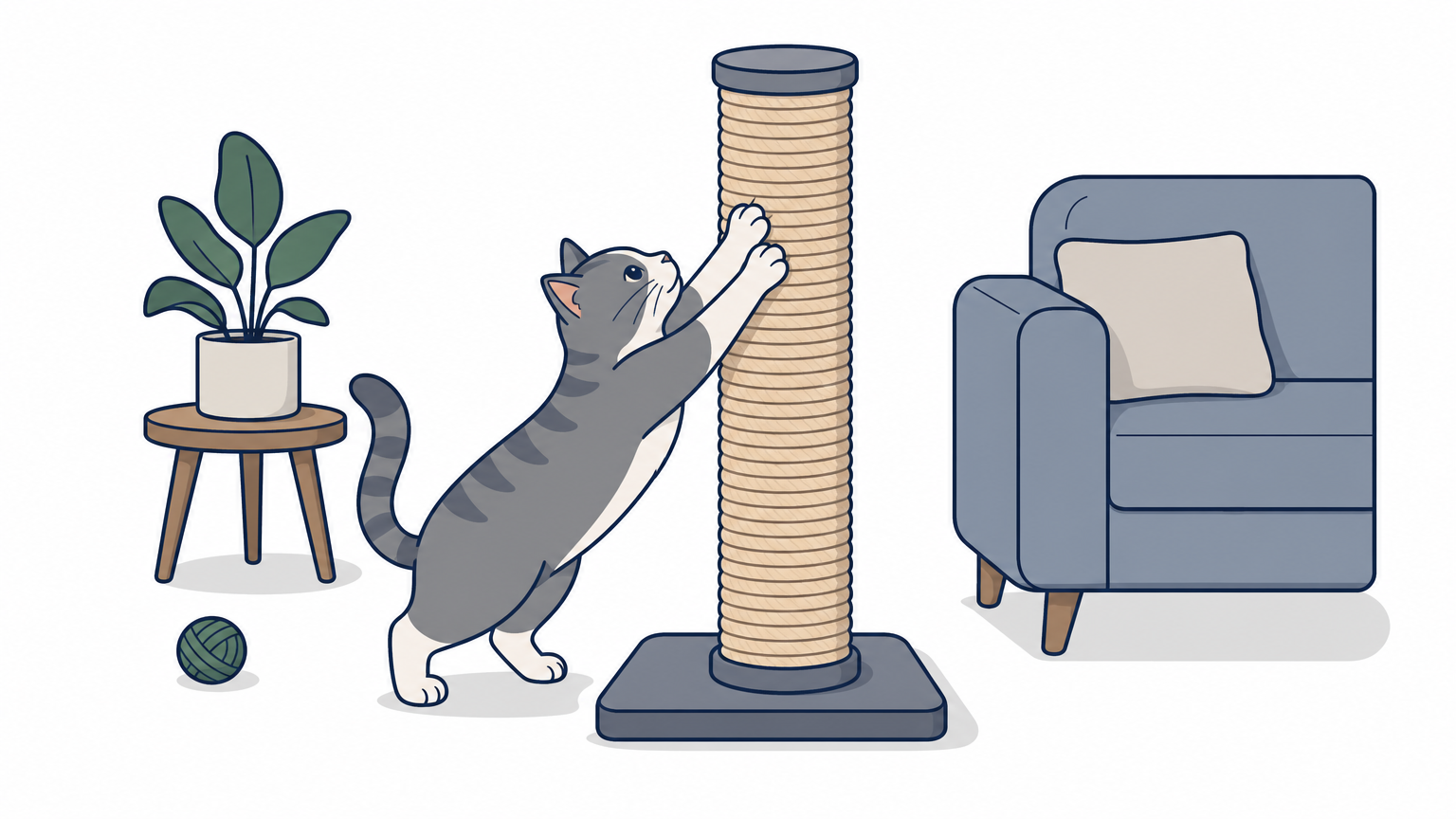
A vertical sisal scratching post is the classic answer to indoor scratching, and for good reason. These posts wrap a wooden or cardboard core in tightly woven sisal rope, giving your cat a tall, stable surface built to mimic the tree bark cats instinctively want to claw in the wild. Unlike a couch cushion, sisal offers resistance that satisfies the deep stretch-and-shred motion cats crave, which is why it’s one of the most recommended tools for anyone trying to protect furniture from cat scratching long term.
How it works
Height matters more than most owners expect. A post needs to stand at least 28 to 32 inches tall so your cat can fully extend its body during a scratch, since a stretch that gets cut short sends them right back to the couch arm for a better reach. The base also needs enough weight or footprint to stay steady under an aggressive scratch, because a wobbly post teaches your cat that the sofa is the more reliable option.
A post that wobbles loses to a couch that doesn’t.
Who it’s for
Owners with a cat that already shows interest in scratching upright surfaces, like door frames or stair banisters, will see the fastest results here. It also pairs well with the corner protectors covered above, since placing a sisal post right next to a blocked corner gives your cat an immediate, satisfying alternative in the same territory.
Price range
Basic single posts run $15 to $35, while taller, weighted, or designer versions among the best scratching posts climb to $40 to $70. Replacement sisal wraps, needed once the rope frays down to bare wood, cost around $10 to $20.
6. Wall-mounted cat scratchers
Wall-mounted scratchers solve a problem floor posts can’t: they save space while still giving your cat a vertical surface to work with. These are sisal-wrapped or carpeted planks that screw directly into a stud, positioned at cat height so your cat scratches the wall panel instead of the couch beside it. For small apartments or narrow hallways where a bulky post won’t fit, this is one of the more practical cat scratching furniture protectors you can install.
How it works
The panel mounts flush or at a slight angle against the wall, usually near a doorway or the exact spot your cat already targets on nearby furniture. Cats brace against the wall itself for resistance, so the mount needs to be anchored into a stud or with heavy-duty anchors, not just drywall screws, or it’ll pull loose after a few weeks of daily use. Brands like Pioneer Pet and Tuff Scratcher sell interlocking panel sets, letting you angle multiple boards into a corner ramp shape for cats that like climbing while they scratch.
A scratcher that shares wall space with the couch keeps claws off cushions without eating your floor space.
Who it’s for
This option fits owners in smaller homes or renters who can patch a few screw holes but can’t justify a full cat tree taking up floor space. It also works well for cats that already scratch near doorframes or wall corners, since you’re placing the alternative exactly where the instinct already points. Households with multiple cats often add two or three panels at different heights to reduce competition over one spot.
Price range
Single wall panels run $20 to $45, while multi-panel ramp sets climb to $60 to $100. Mounting hardware is usually included, though sturdier anchors for non-stud walls may cost a few dollars extra.
7. Horizontal floor scratcher lounges
Some cats don’t scratch upright at all, they stretch out flat and rake their claws sideways across the floor or a low cushion. If that sounds like your cat, a horizontal floor scratcher lounge gives them a dedicated flat surface instead of your rug or the base of the couch. These are corrugated cardboard or sisal-topped pads shaped like a shallow lounge, built specifically as cat scratching furniture protectors for cats who prefer ground-level clawing over vertical posts.
How it works
The lounge sits flat on the floor, usually near a favorite napping spot or right beside the couch where your cat currently scratches. Cardboard versions wear down in layers, showing visible grooves as your cat digs in, which most owners find satisfying to watch and easy to gauge for replacement timing. Sisal-topped lounges last longer under heavier cats or aggressive scratchers, though they cost more upfront. Brands like SmartCat and PetFusion sell curved or double-wide versions that also double as a resting spot, so the lounge earns its floor space even between scratching sessions.
A cat that scratches sideways needs a sideways surface, not another vertical post it’ll ignore.
Who it’s for
This option suits owners whose cat already scratches rugs, carpet edges, or the base of furniture rather than the arms or back. It’s also a smart add for households that already own a vertical post, since offering both orientations covers more of your cat’s natural range of motion. Skip it if floor space is tight, since these lounges need a few square feet of open area to be effective.
Price range
Cardboard lounges run $10 to $20 and typically need replacing every two to four months. Sturdier sisal or reversible versions cost $25 to $45 and last considerably longer under daily use.
8. Multi-level cat trees
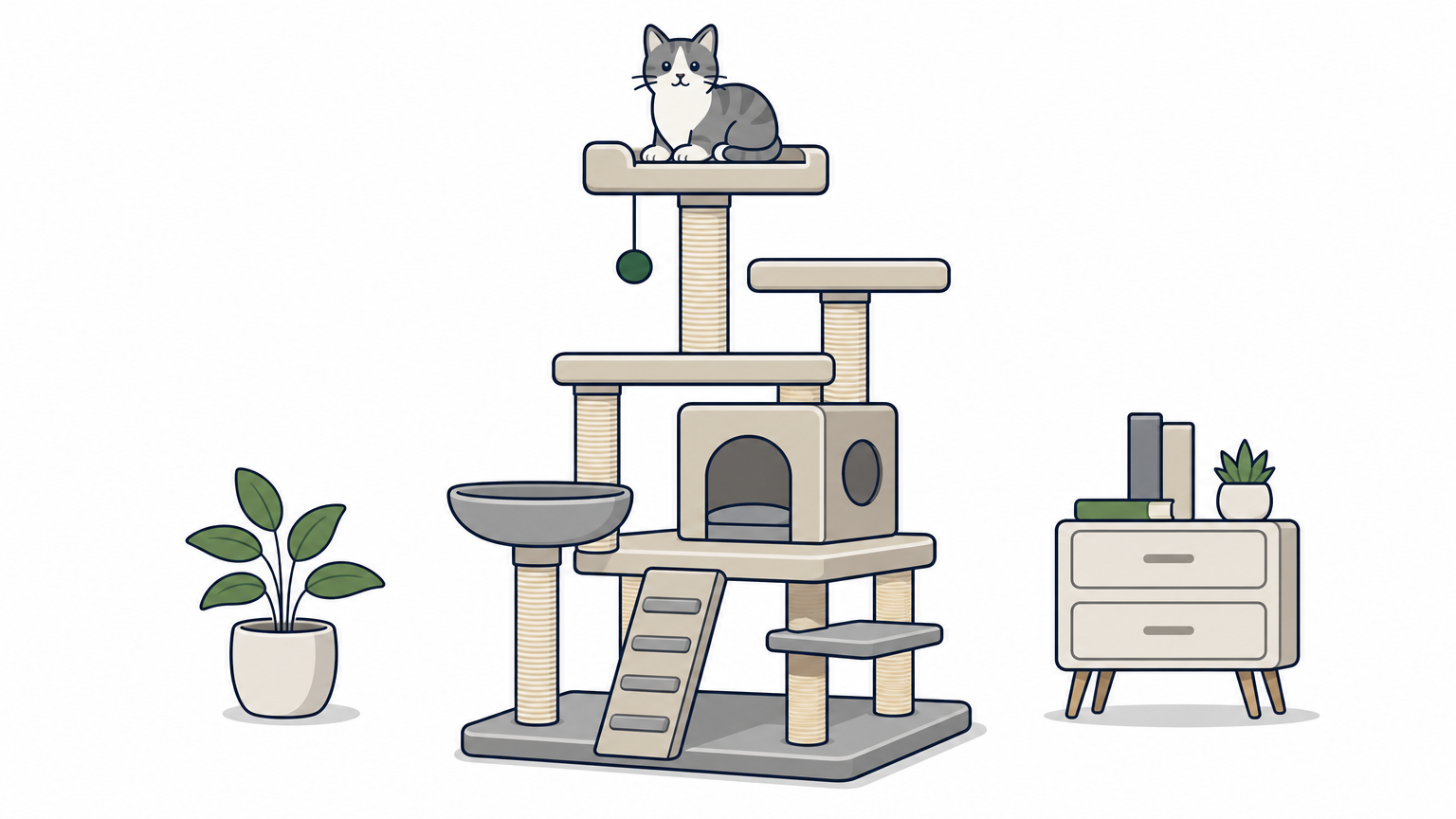
A multi-level cat tree gives your cat an entire vertical territory instead of one post, combining scratching posts, platforms, and hideaways into a single piece of furniture. For cats that climb, perch, and scratch as part of the same routine, this is one of the most complete cat scratching furniture protector setups you can buy, since it satisfies more instincts than a single-purpose product ever could.
How it works
Sisal-wrapped posts anchor each level, giving your cat a scratching surface every time it climbs up or down, while platforms and enclosed boxes offer resting spots that pull attention away from the couch entirely. Taller trees, especially those reaching 60 inches or higher, tap into a cat’s instinct to survey territory from above, which keeps them occupied on the tree instead of prowling the living room looking for something to claw. Brands like Frisco and Go Pet Club build wide, weighted bases that stay steady even when a cat launches off a top platform, which matters more than most owners expect since a tippy tree gets abandoned fast.
A tree that covers climbing, resting, and scratching in one unit beats three separate products your cat only half-uses.
Who it’s for
Multi-level trees suit owners with the floor space to spare and a cat that already shows climbing behavior, jumping onto bookshelves or the back of the couch. They’re especially useful in multi-cat households, where separate platforms reduce territory disputes that often show up as extra scratching. Skip this option if you’re in a small apartment, since a cramped placement defeats the purpose and just becomes another obstacle.
Price range
Entry-level trees run $50 to $90, while larger, multi-platform towers with enclosed boxes and thick sisal posts climb to $120 to $250. Premium modular designs that let you add or rearrange sections cost $250 and up, though replacement sisal wraps keep ongoing costs modest.
9. DIY couch covers and throws
Sometimes the simplest fix is the one you already have in a closet. A thick blanket, quilted throw, or fitted slipcover tossed over your couch creates an instant barrier between claws and cushions, and it’s the go-to answer for anyone searching how to protect your couch from cat scratches without buying specialty gear. Tight-weave fabrics like canvas, denim, or microfiber hold up far better than knit throws, which snag and unravel the first time a claw catches a loop.
How it works
A cover works purely by blocking contact, the fabric itself isn’t meant to be scratched, it’s meant to absorb the attempt before claws reach upholstery. Tucked-in or elastic-hem covers stay put better than draped throws, which slide around every time your cat jumps up. For the best couch covers to prevent cat scratches, look for:
- Tight woven fabric (canvas, denim, ripstop)
- Elastic hems or tuck-under flaps to prevent sliding
- Machine-washable material for easy cleanup
- Dark or patterned prints that hide fur and snags
A cover only protects the spot it’s actually covering, cats find the exposed edge fast.
Who it’s for
This option fits budget-conscious owners who want a furniture protector for cat scratching they can wash, swap, or replace without much cost. Renters like the flexibility, since nothing gets glued or screwed to the couch itself. It’s a weaker fit for households with determined scratchers, since claws eventually find the seams or edges a throw doesn’t fully cover.
Price range
Basic throws start around $15 to $25, while fitted slipcovers built for pet households run $30 to $60 depending on couch size and fabric quality.
10. Leather-safe furniture protectors
Leather couches present a different problem than fabric ones. Claw marks don’t just snag threads, they gouge and tear the surface, and once leather rips, it doesn’t heal the way fabric can be rewoven or covered. Owners with leather furniture need a furniture protector from cat scratching built specifically for that material, since generic vinyl guards or sticky tape can leave residue or discoloration on treated hides.
How it works
Most leather-safe protectors use a soft, non-adhesive clear film or a breathable fabric shield designed to sit flush against the leather without trapping moisture underneath, which matters because leather left damp under plastic can crack or mildew over time. Straps or weighted edges hold the shield in place instead of glue, so nothing pulls at the finish when you remove it. Some brands, like Leather Guard Pro, add a slight texture to the outer surface that still discourages clawing without the stiff, crinkly feel of standard vinyl.
Leather doesn’t forgive a wrong protector the way fabric does, so match the material or risk permanent damage.
Who it’s for
This option suits owners of genuine or bonded leather sofas who’ve already dealt with one torn cushion and don’t want a repeat. It’s a smart pick for anyone trying to protect furniture from cat scratching on a piece too expensive to replace casually, and it works well alongside a nearby scratching post since leather rarely satisfies a cat’s texture preference anyway.
Price range
Leather-specific shields typically run $25 to $50 per panel, higher than standard vinyl guards because of the specialized non-adhesive backing. Full-sofa leather protectors climb to $60 to $90, and they’re worth the extra cost given how much a single deep gouge can cost to repair professionally.
11. Calming sprays and pheromone diffusers
Stress plays a bigger role in scratching than most owners realize, and calming sprays or pheromone diffusers tackle that root cause instead of just blocking claws. These products release synthetic versions of the pheromones cats naturally produce when they feel secure, aiming to reduce the anxiety-driven scratching that often shows up after a move, a new pet, or a change in routine. They won’t stop territorial or claw-maintenance scratching on their own, but as part of a broader plan to protect furniture from cat scratching, they take pressure off the couch by calming the cat down first.
How it works
Diffusers plug into an outlet near the area your cat frequents most, releasing a steady, odorless dose of synthetic feline facial pheromone over several weeks. Sprays work faster but wear off within hours, so they’re better suited to specific triggers, like spraying a carrier before a vet visit or a new piece of furniture before your cat investigates it. Brands like Feliway dominate this category, and most versions are backed by feline behaviorist input rather than pure marketing claims.
Calm cats scratch less out of stress, but they still need a proper post for instinct-driven scratching.
Who it’s for
This option suits owners dealing with sudden scratching spikes tied to an obvious stressor, like a recent move or a new baby in the house. It’s a weak standalone fix for cats that scratch simply out of habit or territory marking, so pair it with a scratching post or one of the furniture protectors from cat scratching covered above rather than relying on it alone.
Price range
Diffuser starter kits with a plug-in unit and one refill run $15 to $25, with refills costing $12 to $18 every four to six weeks. Spray bottles are cheaper, typically $10 to $15 per bottle.
12. How to choose the right protector for your home
Picking the right cat furniture protector scratching solution starts with watching your cat before you buy anything. Notice whether it scratches upright, like a couch arm or door frame, or flat across the floor and rug edges, since a vertical sisal post won’t help a cat that scratches sideways. Also factor in how many cats share the space, because multi-cat households usually need more than one type of protector to avoid territory disputes that just push scratching onto a different piece of furniture.
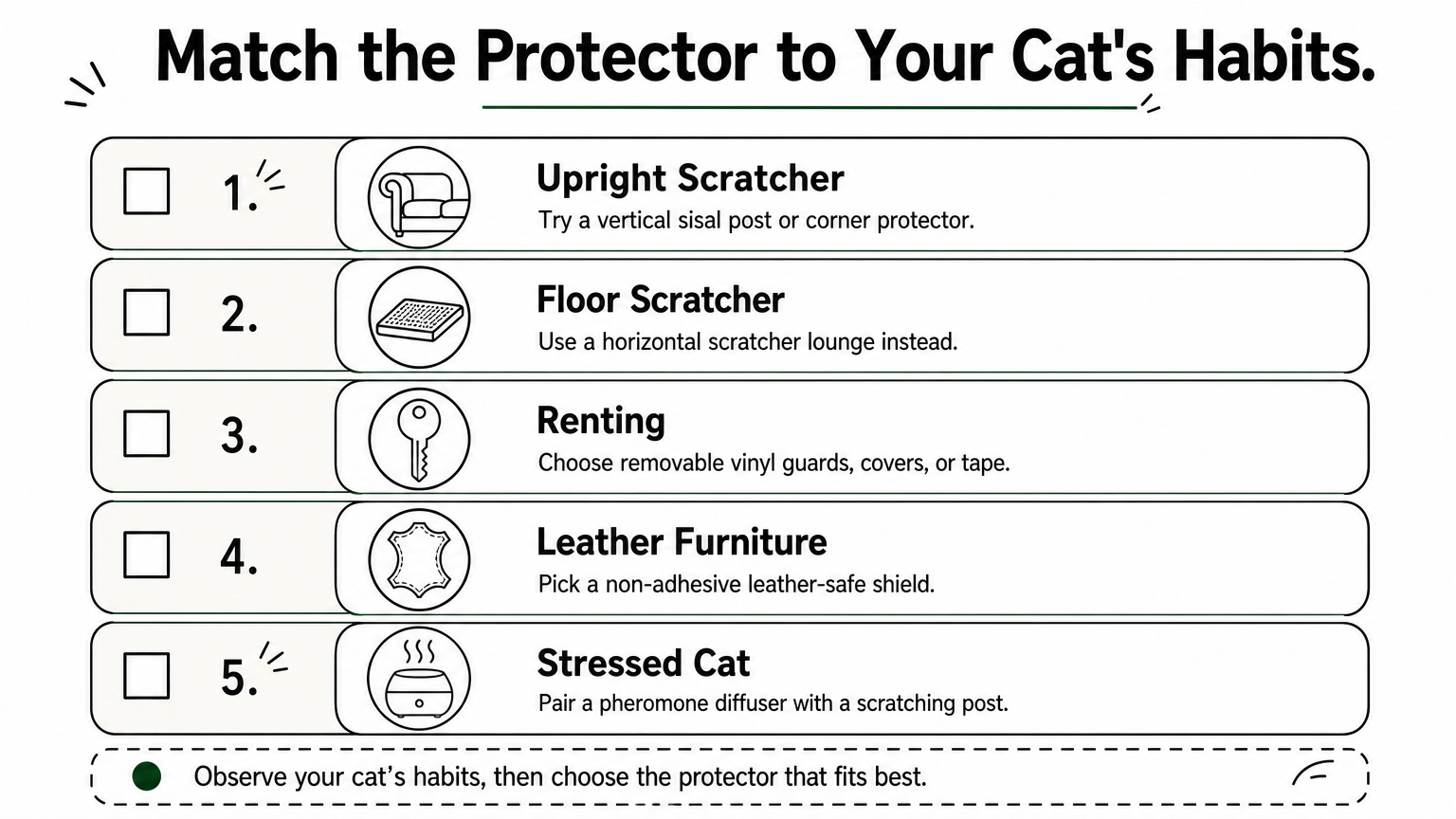
Budget and permanence matter just as much as behavior. Tape and vinyl guards cost little upfront but need constant replacing, while a scratching post or trained habit costs more time initially but saves money over years of couch repairs.
The best protector matches your cat’s actual scratching style, not just the spot on your couch that’s already damaged.
Material compatibility is the detail most owners skip. Leather needs a non-adhesive shield, fabric tolerates tape and vinyl fine, and rented homes call for anything removable without leaving marks. Use this quick reference to narrow your pick:
| Your situation | Best fit from this list |
|---|---|
| Cat scratches couch arms upright | Vertical sisal post, corner protector |
| Cat scratches floor or rug flat | Horizontal floor lounge |
| Renting, need removable options | Vinyl guards, DIY covers, tape |
| Leather furniture | Leather-safe protector |
| Recent stress or move | Pheromone diffuser plus a post |
| Want a permanent fix, not a cover-up | Scratch-Free in 7 Days |
Whatever combination you land on, pair a physical barrier with a legitimate scratching outlet nearby. Guards alone rarely change behavior long term, they just relocate it.
13. Common questions about protecting furniture from cats
Owners searching for a furniture protector for cat scratching usually land on the same handful of questions, so here are the ones that come up most.
Will my cat eventually ignore a scratching post if I use a cover instead? Yes, if the cover works too well. A cat that can’t reach the couch at all sometimes just stops trying anywhere, but most redirect to whatever surface is still available, including carpet edges or a chair you forgot to protect. Pairing a barrier with a post nearby prevents that shift.
Do cats grow out of scratching furniture on their own? Rarely. Scratching is tied to claw maintenance and territory marking, both of which persist for a cat’s entire life. Without a trained alternative, an older cat scratches the same spots it always has, just with a decade of accumulated damage.
Can I combine multiple protectors at once? Absolutely, and most successful setups do. A common combination is a corner protector on the couch, a sisal post nearby, and a diffuser running in the background for a cat under stress. Layering options covers more of a cat’s natural scratching range than any single product on its own.
No single product replaces a trained habit, but the right combination buys you time while that habit forms.
How fast should I expect results? Tape and vinyl guards work within days since they simply block access. Redirecting instinct through a post or a structured training method typically takes about a week of consistent placement, which is faster than most owners assume once the right surface is in place at the right time.
Finding the right fit for you and your cat
Covers, tape, and posts all buy you time, but none of them touch the instinct driving the scratching in the first place. That’s the gap between managing damage and actually fixing it. Pick a cat furniture protector scratching solution that matches how your cat actually scratches, upright or flat, alone or in a multi-cat household, and pair it with a real outlet nearby so the barrier isn’t the only thing standing between claws and cushions.
Deterrents wear out. Adhesive peels, tape loses its stick, and a cat that’s motivated enough will eventually find the one spot you missed. Retraining the habit is the only fix that doesn’t need constant upkeep. If you’re ready to stop patching furniture and start solving the actual problem, read our Scratch-Free in 7 Days review and give your cat a better place to put those claws for good.